
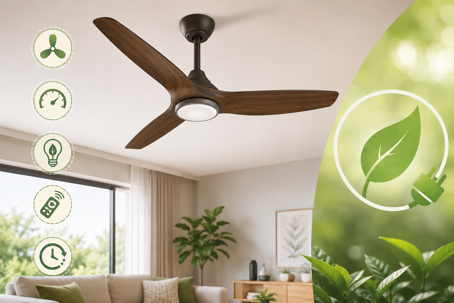
Your ceiling fans might be running all summer in San Antonio, but they may not be doing nearly as much for your electric bill as you think. Many older fans move a little air, add a lot of light wattage, and run on inefficient motors that quietly waste power hour after hour. The good news is that newer energy-saving ceiling fan features can turn that constant spinning into real comfort and meaningful support for your cooling system.
In our climate, the air conditioner often kicks on in March and keeps working hard well into the fall. Fans are not just decoration, they are one of the few devices that can make a room feel cooler without dropping the thermostat. The right combination of motor, blade design, lighting, and controls can let many San Antonio homeowners stay comfortable with the thermostat set a bit higher, which reduces how long the AC has to run.
At Absolute Power Electrical Contractors, we have been wiring and installing fans and lighting in San Antonio, Boerne, and nearby communities since 2005. As a local, family-owned electrical contractor, we see every day which ceiling fans actually keep rooms comfortable and which ones just look nice on the ceiling. Below, we will walk through the top energy-saving ceiling fan features to consider so you can choose fans that work for your home instead of against your electric bill.
Why Energy-Saving Ceiling Fans Matter In San Antonio Heat
San Antonio summers do not just bring a few hot days, they bring months of high temperatures and heavy humidity. Many homes run the air conditioner for long stretches, then still have rooms that feel a little stuffy or warm. Ceiling fans help by moving air across your skin, which speeds up evaporation and makes you feel cooler, even though the actual air temperature has not changed.
That difference in comfort is important. If a room feels a couple of degrees cooler because of good airflow, a lot of families are comfortable nudging the thermostat up a notch instead of down. That small adjustment can mean the AC compressor cycles on less often, especially in the evenings and at night. Over our long cooling season, that change in runtime can have a noticeable effect on how much energy your home uses.
Many homeowners assume that any spinning fan equals energy savings, but that is not always the case. Older fans with inefficient motors and dim incandescent bulbs can draw more power than you expect, while only moving a modest amount of air. We routinely walk into San Antonio homes where the fan is running constantly and the family is still uncomfortable. Upgrading to a modern, well-chosen fan can change how that room feels and reduce wasted watts at the same time.
Because we work in so many local homes, we see patterns. Certain house plans, such as open-concept living rooms, two-story entries, and covered patios, tend to be hot spots where the right fan makes a real difference. When you think about energy-saving ceiling fans in San Antonio, picture them as part of your overall cooling strategy, not an afterthought. That mindset helps you choose features that will actually support your AC instead of just adding another motor to your electric bill.
DC Motors Vs. AC Motors: The Heart Of An Energy-Saving Ceiling Fan
The motor inside your fan is the main driver of how much electricity it uses. Traditional ceiling fans use AC (alternating current) motors. These have been standard for decades and can still perform well, but they are usually less efficient and offer fewer speed settings. Newer DC (direct current) motors take the incoming AC power and convert it to DC inside the fan, then use electronic control to drive the motor more precisely.
In practical terms, a modern DC motor fan often uses noticeably less power than many older AC motor fans while delivering similar or better airflow. DC motors also tend to run quieter, which matters in bedrooms and home offices where fan noise can be distracting. Because they are electronically controlled, they usually offer more speed options, so you can fine-tune airflow instead of jumping between just a few speeds.
Energy-saving ceiling fans for San Antonio do not all have to be top-tier DC models, but it is worth knowing where a DC motor makes the most sense. We often recommend prioritizing DC fans in rooms where the fan runs the longest, such as primary bedrooms and main living areas. If a fan is on for many hours a day across months of hot weather, the difference in motor efficiency plays a bigger role than in a guest room that sees occasional use.
We also look at the fan’s published performance data when helping homeowners compare models. Some efficient AC motor fans perform quite well, especially at lower speeds, but many older designs do not. When our electricians help you evaluate options, we review the motor type along with airflow and wattage, then match that to how your family actually uses each room. That way, you are not paying extra for a feature that does not fit your needs, or missing out on efficiency where it matters most.
Airflow, Blade Design, & Room Size: Getting Real Comfort From Your Fan
Even the most efficient motor will not help much if the fan is not moving enough air through the room. Manufacturers publish airflow ratings in CFM, which stands for cubic feet per minute. This number tells you how much air the fan moves at a given speed. For energy-saving fans, another helpful figure is CFM per watt, which shows how much airflow you get for each watt of power the fan uses.
Blade span and blade pitch also play a role. Blade span is the diameter of the circle the blades make, for example 44 inches or 60 inches. Blade pitch is the angle of the blade relative to the horizontal plane. For most residential ceiling fans, a pitch in the typical residential range, combined with a suitable motor, can move a strong volume of air. A very flat blade often moves less air, while an extreme pitch can overload a weak motor.
Room size is another key factor. In a small bedroom, a compact fan may be enough, but in an open-concept living room or game room, a larger fan or even multiple fans may be needed to cover the space. We often see San Antonio homes with a small fan centered in a big room, which leaves the corners and seating areas feeling warm. In high-ceiling rooms, the fan may sit too close to the ceiling, reducing its ability to pull and push air effectively.
Ceiling height and downrod length matter as well. Most fans are designed to work best when the blades sit several feet below the ceiling. In homes with vaulted or tall ceilings, installing an appropriate downrod can dramatically improve how the air feels at sitting and standing height. As electricians, we also check that the electrical box is fan-rated and that the support structure can handle larger, heavier fans. Safe, solid mounting is critical, especially when you are installing a higher-CFM fan that will run for many hours.
Integrated LED Lighting: Cutting Wasted Watts Overhead
Lighting built into a fan can quietly add a surprising amount of energy use. Older ceiling fans often use multiple incandescent bulbs in globes or glass shades. Each of these bulbs may draw several times more power than an equivalent LED, and they also create more heat, which is not what you want in a San Antonio summer. Over time, that extra heat and wattage work against your goal of reducing cooling load.
Modern energy-saving ceiling fans commonly include integrated LED lighting. These LED modules are designed to provide the same or better brightness as older multi-bulb fixtures, while drawing far fewer watts. They also run cooler and generally last longer, which means fewer bulb changes and less time up on a ladder. When you combine an efficient motor with efficient lighting, the total impact on your electricity usage is much lower than a fan with incandescent bulbs.
Color temperature and brightness also deserve attention. Many San Antonio homeowners prefer warmer light in bedrooms and cooler light in kitchens or workspaces. A good LED fan light allows you to get the right feel without needing higher wattage just to see clearly. When our team helps plan lighting, we look at existing fixtures in the room and help you choose fans that will fit in visually and functionally, so you are not tempted to add extra lamps to compensate for a dim fan light.
There are occasional concerns about what happens when an integrated LED module eventually needs service. Quality fans are designed with long-life LEDs, so replacement is not a frequent task for most households. When an issue does come up, having a fan that was installed correctly and wired properly makes any future service simpler and safer. Our electricians install many different LED fan models, so we can help you choose options that balance efficiency, appearance, and long-term practicality.
Smart Controls & Settings That Reduce Wasted Fan Run Time
Even a very efficient fan can waste energy if it runs full blast in an empty room. This is where smart controls and thoughtful settings come in. Some fans include their own remotes or app-based controls, while others can be paired with wall-mounted smart switches or integrated into broader smart home systems. Used correctly, these tools can keep fans running when people are in the room and off when they are not.
Useful features include scheduling, occupancy sensing, and grouping. Scheduling lets you set fans to run at certain speeds during predictable times, such as low speed at night in bedrooms and higher speed in the late afternoon in living areas. Occupancy sensors can turn fans on when they detect movement and off after a set time without activity. Grouping allows you to control multiple fans in a space, for example, several fans on a large patio or in an open kitchen and living room, so they work together instead of separately.
Seasonal direction settings are another simple but powerful tool. In summer, the fan should typically run counterclockwise, pushing air downward to create a cool breeze. In winter, many fans can be set to clockwise at a low speed, which gently circulates warm air that accumulates near the ceiling without creating a strong draft. Using the correct direction for the season can improve comfort and help your heating and cooling system work more evenly.
Compatibility does matter. Not every fan and smart switch combination works properly together, and not every switch is designed to handle the electrical characteristics of a fan motor. Some modern DC fans use remotes or control modules that need to stay in the system. Our team at Absolute Power Electrical Contractors regularly integrates fans into smart home setups, and we make sure the controls are fan-rated, wired correctly, and configured so you get the convenience and energy benefits without buzzing, flickering, or nuisance tripping.
Indoor, Outdoor, & Patio Fans: Matching Ratings To San Antonio Conditions
San Antonio homes often have covered patios, porches, and outdoor kitchens where a ceiling fan can make the space usable on hot evenings. Not every fan is built for these conditions, though. Fans are rated as dry, damp, or wet, and each rating tells you where the fan is intended to live. Using the wrong rating in the wrong place can shorten the fan’s life and waste your investment.
Dry-rated fans are meant for indoor spaces that are not exposed to moisture, such as bedrooms, living rooms, and offices. Damp-rated fans are designed for covered outdoor areas where they may encounter humidity or occasional wind-blown moisture, but not direct rainfall. Wet-rated fans are built to handle direct exposure to rain and are suitable for locations where water may reach the fan directly.
In our area, humidity, dust, and heat on patios and in garages are tough on improperly rated fans. We often see rusted hardware, warped blades, and failed motors on indoor fans that were installed outside to save a little money up front. Those fans tend to use more energy as they age and run less smoothly, so they cost more to operate and need to be replaced sooner.
Energy-saving outdoor fans use materials and finishes that resist corrosion, and their motors are sealed to help keep out moisture and debris. Choosing the right rating the first time protects your investment and keeps airflow strong for years instead of just a few seasons. Our electricians help homeowners in San Antonio and Boerne sort through ratings and options, then install fans in a way that protects both the fan and the home’s electrical system from the elements.
Professional Installation: Where Safety & Performance Come Together
The features printed on the fan box only deliver their full benefit if the fan is mounted and wired correctly. A powerful, high-CFM fan installed on a box that was only rated for a light fixture, for example, can loosen over time, wobble, or even fail. As licensed electricians, we start every fan installation by confirming that the electrical box is fan-rated and that the structure above the ceiling can support the fan’s weight and motion.
We also look at the circuit and controls feeding the fan. Many older homes have fans tied into dimmer switches that were designed for lights, not motors. This can cause humming, overheating, or flickering lights when you add modern LED lighting. When we upgrade a fan, we often replace incompatible controls with fan-rated switches or smart controls that match the new fan’s requirements.
DIY fan projects can create subtle problems that show up later as noise, vibration, or nuisance breaker trips. We commonly find loose connections in wire nuts, box screws that were not tightened fully, or support brackets that are not attached to solid framing. These issues can shorten the life of the fan and make it less efficient, because a wobbling fan may not move air evenly and may need to run at higher speeds just to feel effective.
Absolute Power Electrical Contractors has built a strong reputation in the San Antonio area, including an A+ rating from the Better Business Bureau and a 5.0 average rating on Angi. Our team of trained electricians handles everything from straightforward fan replacements to more complex projects, such as adding new fan locations, running new circuits, or tying multiple fans into smart controls. When we install an energy-saving ceiling fan, we focus on safety, quiet operation, and performance, so you actually get the comfort and efficiency you invested in.
Putting It All Together: How To Choose The Right Energy-Saving Ceiling Fans
Choosing the best energy-saving ceiling fans for a San Antonio home starts with a simple checklist. Look for an efficient motor, often a DC motor in rooms where fans run the longest. Check the airflow rating in CFM and pay attention to CFM per watt so you know you are getting strong airflow for the power used. Make sure the blade span and pitch match the size and height of the room, and that the fan rating, dry, damp, or wet, fits where you plan to install it.
Next, consider lighting and controls. Integrated LED lighting cuts wasted watts and heat, especially in spaces where lights and fans are on together for hours. Smart controls, fan-rated switches, or good-quality remotes help you run the fan only when and how you need it. In living rooms and primary bedrooms, where comfort is critical and runtime is long, investing more in energy-saving features often makes sense. In lightly used guest rooms, a solid mid-range fan with LED lighting may be all you need.
Every home is different, and so is every electric bill. Some homeowners decide to upgrade all their fans at once, while others start with the hottest rooms and plan additional upgrades over time. When we visit a home, we walk room by room, talk through how each space is used, and explain options in plain language. Our Absolute Advantage Membership also offers ongoing electrical checkups and benefits for families who want a long-term plan for comfort and safety.
If you are looking at energy-saving ceiling fans in San Antonio and are not sure where to start, we can help you sort through the choices and handle the installation from start to finish. We treat your home with care, keep work areas clean, and focus on solutions that actually fit your comfort goals and budget.
Upgrade Your Comfort With Energy-Saving Ceiling Fans Installed By Pros
The right ceiling fans will not replace your air conditioner in San Antonio, but they can make your home feel cooler, help your AC work a little less, and trim wasted watts from inefficient motors and lights. By focusing on motor efficiency, airflow, lighting, ratings, and smart controls, you can turn a simple fan upgrade into a long-term improvement in comfort.
If you are ready to replace old, noisy, or inefficient fans, or you want to add new fans to hot rooms or outdoor spaces, our team at Absolute Power Electrical Contractors is ready to help. We can recommend energy-saving ceiling fan options for your specific rooms and install them safely, cleanly, and to current electrical standards.